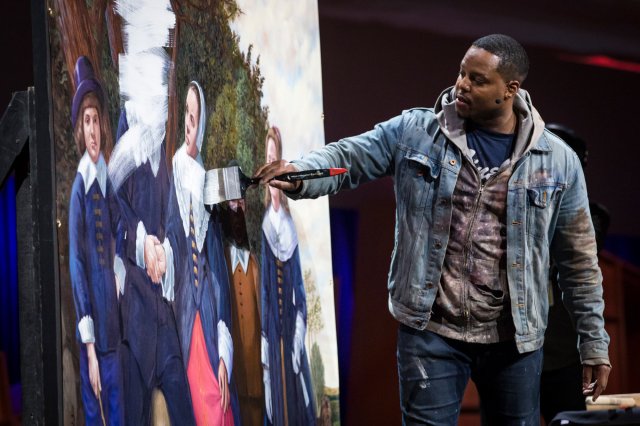
Can art amend history?

20150210104239-Titus_Portrait6_KubiatNnamdie

This week a student sent me an email sharing a link to a TEDtalk she thought I would enjoy. In the message, she said, “I think what he is saying in the video is something you made a huge effort to do in class.”

YES, YES, YES! I can’t describe how happy I was to hear a student not only understand some of what I was trying to accomplish, but also recognize it as part of my teaching philosophy!

Here is the TEDtalk “Can art amend history?” by Titus Kaphar.

ted2017_042417_3rl6456.jpg

Learn more about his work at the Jack Shainman Gallery.  


“There is no Apolitical Classroom”

Screen Shot 2017-08-16 at 2.50.42 PM

What a crazy week it has been. I really wish I was teaching a course on sculpture this fall. Boy would there ever be some interesting conversations.

One of the only positives to emerge amidst some of the heartbreaking recent events has been a tidal wave of conversations, posts, and resources on how to take a stand agains racism.

Yesterday, NCTE’s Standing Committee Against Racism and Bias in the Teaching of English posted the following statement along with these resources “to use as statements of love and support.”

We know that racism exists in our classrooms and in our communities. We feel that silence on these issues is complicity in the systemic racism that has marred our educational system. We see no place for neutrality and urge each member of NCTE to educate as many people as possible about the ways that systemic racism affects all of us in negative ways.

There is no apolitical classroom. English language arts teachers must examine the ways that racism has personally shaped their beliefs and must examine existing biases that feed systems of oppression. In light of the horrific events in this country that continue to unfold, and the latest terrorism in Charlottesville, Virginia, we would like to share resources that we hope will encourage all NCTE members to speak out against the racism and bias that have been a part of our nation’s fabric since the first immigrants disembarked from European ships.


Bloom’s Taxonomy: Art History Edition

Am I the only one super excited to see a Bloom’s taxonomy created for art history?

Document10 copyThanks Laetitia La Follett!

La Follette, Laetitia. 2017. “Bloom’s Taxonomy for Art History. Blending A Skills-Based Approach into The Traditional Introductory Survey.” Art History Pedagogy & Practice 2, (1).

Adopt a Critically Reflective Stance


new-piktochart_23845922_856aaaeabbaf6bc4cd422b8984ef4c8744bd05e4

In The Skillful Teacher, Stephen D. Brookfield emphasizes the importance of teaching that is contextually informed. He explains that this critical reflection is really identifying and questioning if in fact the content we are teaching is accurate and valid for the students.  In order to do so there are four lenses through which we can check the accuracy of our actions and assumptions. The first, students’ eyes, is perhaps obvious but there are three others that provide feedback: colleagues perceptions, educational literature, and our own personal autobiographies (p. 20).

Brookfield, S. (2006). The skillful teacher: On trust, technique and responsiveness in the classroom. San Francisco, CA: Jossey-Bass.

Razvan Sibii

While writing my second reflective journal entry, I came across the work of Razvan Sibii. Sibii teaches in the Department of Communication at the University of Massachusetts Amherst. I find the kind of project based learning he is working on very inspiring!

Check it out HERE!

PIDP 3260 Professional Practice

Professionalism is knowing how to do it, when to do it, and doing it. 

Frank Tyger


Screen Shot 2017-07-31 at 7.18.21 PM

This week I am starting one of my last PIDP courses, Professional Practice. Over the next few weeks you will see several posts based on assignments and reflections on the assigned textbook, The Skillful Teacher: On Technique, Trust, and Responsiveness in the Classroom. 

I am an art historian currently teaching at Langara College and Kwanten Polytechnic University. This year I will have developed and delivered six new courses, most of them well outside my area of expertise. With so many new courses being implemented I am especially interested in gathering feedback from learners.

Each PIDP course transforms how I think about pedagogy and my approach to teaching. And given my professional goals to one day step into university administration I think this class will be equally transformative.

Here’s to lifelong learning and continuous improvement!

Just breathe

yogainorillia-momandbaby

I took my first yoga class, at a rec centre in the fall of 2001. Needless to say my practice has ebbed and flowed considerably since then. At times I went daily to rigorous, hot classes, others I barely moved into poses at all. Over the years it has expanded from an asana only form of exercise, to a more nuanced but broadly defined experience of yoga. And it changed forever last year when I became pregnant.

I was fortunate to continue an active asana practice throughout my pregnancy, even completing my yoga teacher training during the time. Only in the last trimester did I slow down and focus more on restorative classes. In fact I credit my relaxed, healthy experience to regularly attending a variety of hatha and vinyasa classes, prenatal classes, and practicing at home.

Since giving birth to the light of my life Everly Pearl in January I have continued my asana practice. Obviously it has changed greatly; I don’t think I have even attempted many arm balances and I have to be careful in deep hip-openers because I can still feel the extra flexibility in my hips from all the relaxin and other hormones. But the constriction of my asana practice has lead to an expansion of the other eight limbs of yoga.

Never have I felt more present in my body. It started during my pregnancy when everyday I could feel changes occurring. And now when I am with my baby, I feel a deep connection to the present moment. There is really is only the here and now. It doesn’t matter if she slept last week or how many diapers she used yesterday. Every moment with her is different. She is growing and changing and developing so quickly, I have learned that I cannot look to what happened last night to determine what she would do today. And perhaps more importantly I have stopped worrying about what could happen.

After we brought her home from the hospital, Dennis went out to get groceries and I was truly alone with her for the first time. Every few minutes I would check to see if she was breathing. I remember thinking to myself “What if she stops breathing? What if something happens? What if… What if…” And then I made a decision that I would not parent out of fear. I will not dwell in the past or be anxious of the future. I will enjoy every moment with her. And sometimes that means just breathing.

Unlike many women in the world, I am fortunate enough to be on a paid maternity leave that affords me the luxury of living in the moment. At first I was worried I would be bored. After years of working hard what would I do all day? Turns out plenty. She sleeps, eats and plays. I sleep, feed her, and play with her. But there is very little structure to our days. And this has taught me to let go and live in the here and now.

I am lucky that Everly sleeps well and that has allowed for me to still do some of the things I love. I have maintained my sadhana. And I am able to sit and meditate on my own. But I have also been surprised by the meditative time she and I share. When I nurse her I can’t multi-task. I sit, hold her and breathe. I feel united with all mothers before me and to those that will come. I feel connected to her and to myself.

And it is the most yogic act of all.

“Sparking” and “Curating” as Student Engagement Techniques

stock-footage-pink-heart-confetti-and-sparks-in-slow-motion

In a recent post on my favourite blog, Art History Teaching Resources, Elena FitzPatrick Sifford discusses Interactivity and Communication in the Art History Classroom. She explains that her recent survey  courses had interactive components:

In the lecture course students chose a subject from the course calendar and were assigned to a group. They were tasked with putting together a presentation on that topic during one fifty-minute class session. They were asked to lecture and to ask the class questions in order to foster classroom involvement. The class met three times a week, so there was still plenty of time for me to fill in the gaps as needed. In fact, I would often treat the student presentation as an introduction to the topic, which I would then fill in in more depth during the next one or two class sessions. There was no paper component to this assignment, but I found that students had to do a fair amount of research, particularly for some of the lesser-published topics. Many of them were nervous about public speaking, but they rose to the occasion, and there were even some good classroom discussions generated from these presentations. Overall, I think it was successful in having students generate some of the content of the course and getting away from the authoritative talking head model of so many lecture style courses.

Her seminar courses incorporated “sparking” and “curating,” two approaches that I would argue constitute student engagement techniques.

With “sparking” (a term that she borrows from her graduate school professor, Dr. Katherine Manthorne)  a team of two students were tasked with starting a conversation about the readings, by  briefly introducing the authors and the main argument of the paper, then asking a series of questions that would lead the class in a conversation about the works. She describes, “After the exchange, I would impress on them the importance of questions that test critical thinking, and they would come back with broader more discussion-oriented inquiries.”

“Curating”  was largely inspired by an assignment written by her colleague Dr. Ananda Cohen Suarez. In this project students curate an exhibition by presenting a title, series of works, location, and researched wall texts. Reflecting on the activity, Sifford noted “when I try this again, I will aim for more interactive moments during the semester for groups to share their progress and for me to respond and provide feedback before the final due date and exhibition “opening.” I’ve found that the most successful interactive assignments require multiple points of critical feedback so that students are getting more out of the process, interacting with their classmates and professor, and ultimately ending up with sharper finished products.”

“Sparking” and “Curating” are both excellent examples of student engagement techniques idea for art history classrooms. I am excited to try both! Elena FitzPatrick Sifford has inspired me. What perfect examples of the Marva Collins, wise words that motivate my teaching. “The essence of teaching is to make learning contagious, to have one idea spark another.”