10+4

In The Online Teaching Survival Guide, Judith Boettcher and Rita-Marie Conrad list 10 (plus 4) best practices for teaching online. I have considered each and here is how I plan to incorporate each one in my upcoming course.

  1. Be present at the course site. One way I am going to be socially present in my upcoming course is to create an introductory post that connects our regular content to the current coronavirus pandemic, and be transparent in describing my own transition to providing the class online.
  2. Create a supportive online course community. In addition to my frequent posts, and short concept videos, one assignment in particular, the Art in Quarantine image recreation project will help create a supportive online course community. Students will be posting these pictures and sharing the process with each other.
  3. Develop a set of explicit expectations for your learners and yourself as to how you will communicate and how much time students should be working on the course each week. This best practice is particularly important during this unprecedented time. Many students will be self-isolating and social distancing. It will help for all of us to have boundaries set by “available times” and expectations around response times. Additionally the next course I teach will be tricky because it is scheduled in a compressed semester over a six-week period. Students and myself will be challenged to spend roughly 20 hours per week on this course.
  4. Use a variety of large group, small group, and individual work experiences. In addition to individual assignments, and small group discussions, I could see Zoom conference calls being helpful for this semester. Many students might be feeling lonely and could use more socialization than in a typical course.
  5. Use synchronous and asynchronous activities. The majority of this course with be asynchronous, but I could see hosting check-ins or office hours synchronously.
  6. Ask for informal feedback early in the term. In the second week of class I will survey the students to see how they are progressing and how I can support their learning. This check-in will be especially important for me as it will be my first time teaching online.
  7. Prepare discussion posts that invite responses, questions, discussions, and reflections. I have some creative discussion questions that will accompany each unit.
  8. Search out and use content resources that are available in digital format. Fortunately for me the course I will be teaching is a first year survey with many open resources available.
  9. Combine core concept learning with customized and personalized learning. Similar to what I would do in a face to face course, I am giving students as Choose your own Adventure assignment that enhances the meaningfulness of the learning.
  10. Plan a good closing and wrap activity for the course. I need to really think about this one, but I might ask students to give advice to future students taking the course.
  11. Assess as you go by gathering evidences of learning. In order to do this I am going to have weekly due dates, and scaffolded assignments.
  12. Rigorously connect content to core concepts and learning outcomes. As part of the introductory survey, I have the opportunity to ask students about one of the learning outcomes they most identify with and answer the question “How do I want to be different in my person, in my mind after this course?” (loc 1938).
  13. Develop and use a content frame for your course. I think in some ways the chronological nature of this course helps create a frame, but I think sharing a visual of the units and how they fit together will be helpful.
  14. Design experiences to help learners make progress on their novice-to expert journey. This is a best practice I really need to consider, and think more about how I will incorporate it.
Highly Recommended Reading

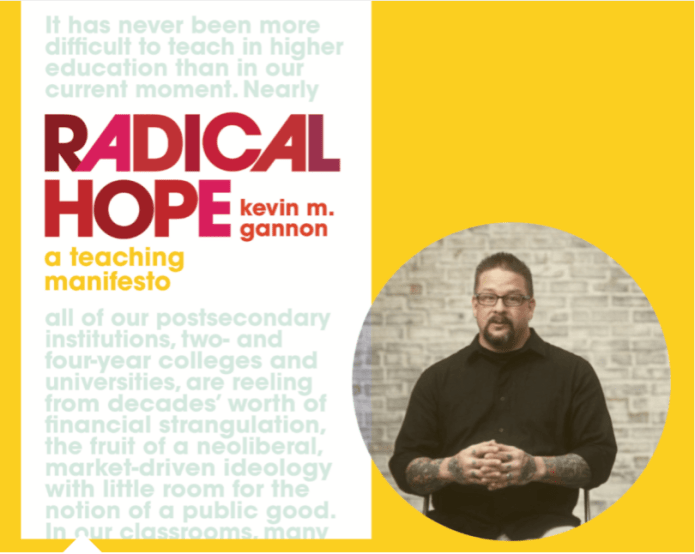
Last night I stayed up way too late reading Kevin M. Gannon’s recently published teaching manifesto, A Radical Hope. I ended up highlighting almost every page. There is so much to think about in this text. Particularly relevant was his discussion of how teaching online can raise accessibility issues that can be helpful to think about in face-to-face teaching as well. He notes he first encountered universal design for learning practices when preparing to teach online. He explains:

Put simply, UDL asks us to stop thinking about disability and accommodations as somehow deviating from the desired norms for teaching and learning, and instead challenge ourselves to create a learning space that might not need to make accommodations in the first place. Rather than pathologizing and ‘othering’ students with disabilities, can we instead approach our worth through a paradigm that allows for diverse ways of learning, and then incorporate that range of difference into our course design and activities? 

Screen Shot 2020-04-05 at 12.50.14 PM

@tussenkunstenquarantine

One of my favorite things to come out of the Covid-19 Pandemic is the Dutch Instagram account @tussenkunstenquarantine. Seeing other’s recreations of art works using household items has inspired me to design something similar for my art history courses. This is a great example shared by @earlybird050

Screen Shot 2020-03-27 at 2.30.25 PM

Combine Knowing

monogramrobertrauschenberg

Robert Rauschenberg, Monogram (1955-9)

In a conversation with Kelly Schrum titled “What’s Wrong with Writing Essays” Mark Sample explained why he was moving away from asking students to write traditional essays. Instead he was asking them to weave – “To build, to fabricate, to design.” He wasn’t trying to create miniature scholars, but rather he called passionately for innovation using a metaphor familiar to art historians. “I want them to be aspiring Rauschenbergs, assembling mixed-media combines, all the while through their engagement with seemingly incongruous materials developing a critical thinking practice about the process and product.”

This semester I had students submit outstanding creative assignments. One student researched Roman hair-styling and recreated the effect of a The Bust of a Flavian Woman. Another wrote a script for a SmArtHistory clip based on a fictional sculpture. And another wrote a fantastic analysis of Roman use of concrete based on his construction experience. These are just a few examples of how students can combine their life experiences, class content, and learning objectives to demonstrate unique ways of knowing. I am inspired by Sample’s approach, and will continue to encourage students to weave their own understandings in higher level, critical thinking.

Panic-gogy

In one of my favourite recent articles “Panic-gogy teaching online classes during the Coronavirus Pandemic” Robin DeRosa explains:

“I think the first thing is we are not building online courses or converting your face to face courses to online learning. Really, what we’re doing is we are trying to extend a sense of care to our students and trying to build a community that’s going to be able to work together to get through the learning challenges that we have.”

I really hope that after the pandemic is over we can all continue to foster a sense of care with our students and build collaborative learning communities.

Screen Shot 2020-03-27 at 2.13.45 PM

Teaching Online

When I finished my Provincial Instructor’s Diploma Program (PIDP) in the summer of 2018 one of my instructors recommended the Online/eLearning Instruction Certificate. I laughed and thought to myself, “nope, never teaching online.”

Well here we are in March of 2020. The Covid-19 Pandemic has struck and like many other profs, I found myself going from the ordinary face to face instruction to online learning – over a weekend. Fortunately for me the two courses I was teaching already had a strong online presence. I was using our LMS for content sharing, assignment submissions, and student communication. It has still been a rocky transition. So here I am taking EDUC 4150 with the hopes of being more prepared for the fall semester.

ETonVGBXgAA0hpN

Meta-Blogging

This semester I am asking students in my Modern Art II/ Contemporary Art and Visual Culture classes to create and maintain a blog. I have tried this assignment in the past, but I was inspired by a recent article on Art History Teaching Resources entitled, Entering the Conversation: Using Student Blogging to encourage Original Writing, Critical Thinking and Personal Investment to try it again.

In the blog post about blog posting assignments, professor Naomi Slipp reflects on what she learned from offering the assignment, including both what went well and what she would change for next time. According to Slipp:

On one hand, the short writing assignments on the course blog seemed like a relaxed way to encourage students majoring in the fine arts to write critically about contemporary visual art and culture in a public platform. The revolving blog format lessened the pressure, since new posts would push old content further down the page. On the other hand, as permanently accessible online writing the stakes of these small assignments were also raised. Each student had to sign their posts encouraging personal investment in their ideas and public ownership of their writing. (Slipp)

Whereas Slipp created one blog for herself and all the students to contribute to, I have asked students to establish their own site to craft individually. See instructions here: Blog Assignment

Over the semester I will also be blogging along and contributing to the conversation. At the end of the semester I will reflect on the process.

Stay tuned for more of my updates.

Reflection on professional practices

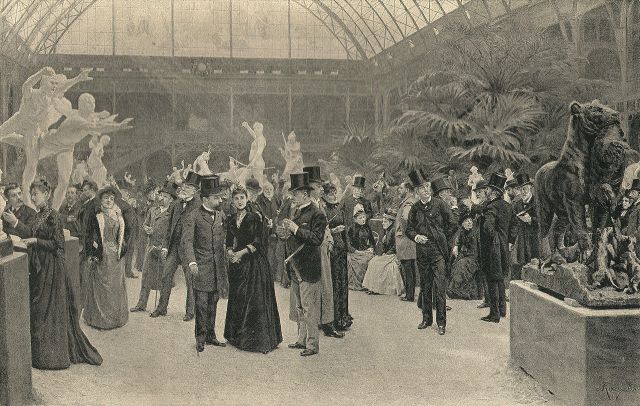
Rixens_jour_de_vernissage.jpg

Teaching is hard. Since returning from maternity leave in January I have taught and will teach eleven courses, ten are new this year and all are outside of my area of specialty. I love working with students, but sometimes it can be draining. The students are becoming increasingly diverse, with a wide range of academic abilities. Sometimes I struggle to meet their needs.

Yes, teaching is hard and sometimes it can be frustrating. And despite the annoying emails, or challenging moments, sometimes we need to remember where students are coming from. Last week I read an article on Active History, that was a good reminder. Elise Chenier, deals with students similar to mine.  They are “largely from lower to middle-income families and attended a public school in the surrounding region. Many hold down one or more part-time jobs, and often are responsible for the care of family members, and sometimes have children of their own.” I too went to Queen’s and art history has to be one of the snobbiest disciplines. Chenier provided food for thought.

She observes how in thinking about her own professional practices she has:

become particularly attuned to how learning requires us to voluntarily enter a state of vulnerability. We must be willing to risk venturing beyond our certainties; to be confused, disoriented, and uncomfortable; to suffer the humiliation of offering a potentially wrong answer in front of our peers and instructors.

The more we make vulnerability possible, the more likely deep and transformative learning will happen.  We can do this by reducing the risks (be aware of how little it takes for a person to feel the shame of another’s judgment; avoid the temptation to admonish) and increasing the supports (encourage rather than judge; query and listen rather than assess; be honest about when we have struggled and perhaps failed, and when we don’t know the answers). This is not a new requirement for a “snowflake” generation. It is simply good teaching.

Chenier ends her piece with these lines that have now become my favourite quote about teaching. Next time I am frustrated and don’t know where to begin I must remember:

You start where your students are. You start by letting go of your idea of who you are and cultivating a curiosity about who they are. You start by making yourself smaller, and them bigger.